Hyperliquid HYPE Token Surpasses $60 to Hit New All-Time High, Driven by Wall Street Institutional Demand
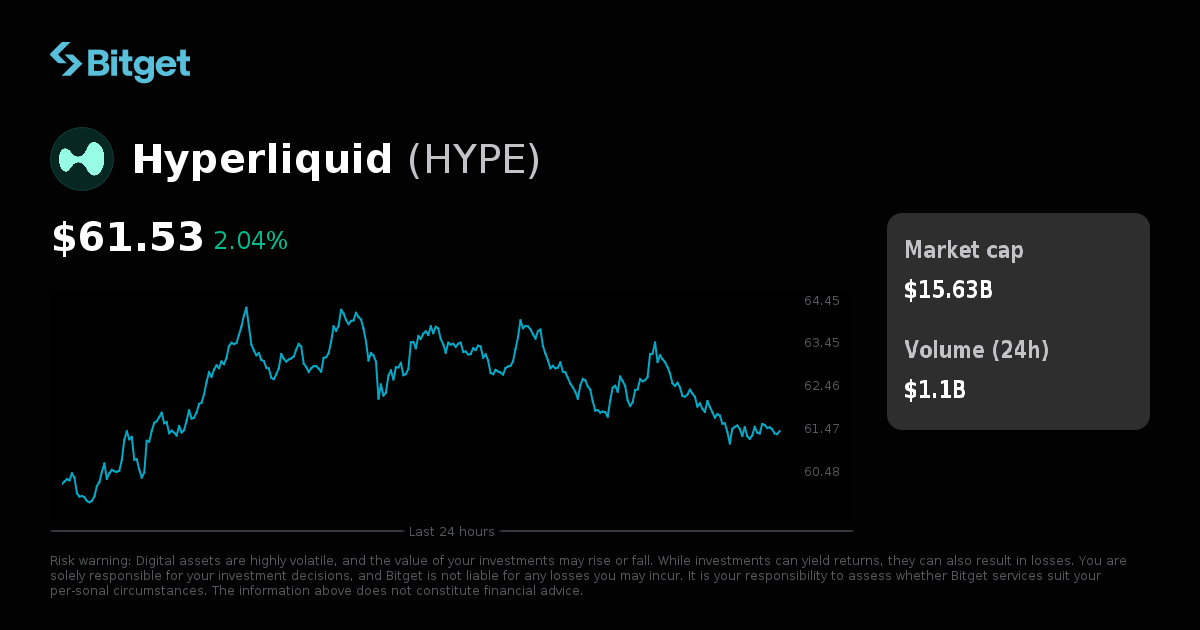
Hyperliquid's HYPE token set a new milestone on May 22, 2026, by breaking the $60 mark. Analysts point to the entry of institutional investors, including Grayscale's massive accumulation and Ripple Prime integration, as the key drivers of this rally.
On May 22, 2026, HYPE, the native token of Hyperliquid, broke through the psychological resistance level of $60 to reach a new all-time high. This surge occurred following a market correction in early 2026, with strong buying pressure since May 21 driving the price up. This record-breaking event is particularly seen as a symbolic milestone, demonstrating that the Hyperliquid protocol has established itself as a core trading platform for institutional investors.
Behind this rally lies massive capital from Wall Street. According to reports, wallets linked to Grayscale have intensively accumulated over $40 million worth of HYPE tokens over the past week. This influx of large-scale institutional capital shows a distinctly different pattern from previous bull markets that relied on speculative demand from retail investors, creating a solid support level for the price.
Looking at the price trend of the HYPE token, it was priced at $7.56 at the time of issuance in November 2024 and reached its first peak at $59.37 in September 2025. However, in January 2026, it retreated to the $25 level alongside a general market correction, causing concern among investors. A gradual recovery that began in April 2026 signaled a reclaim of the $10 billion market cap on May 4 at $41.11, finally culminating in today's record-breaking $60 breakthrough.
HYPE's breakthrough of $60 goes beyond a simple price increase; it suggests that the decentralized perpetual futures market is being integrated into Wall Street's institutional financial infrastructure.
The increase in Wall Street demand is attributed to the institutional-grade trading environment provided by Hyperliquid. Institutional investors are no longer relying solely on centralized exchanges and are turning to decentralized platforms with transparent on-chain order books. In particular, Hyperliquid's high liquidity and low slippage act as attractive factors for institutions managing large-scale funds, leading to actual buying pressure.
Building Financial Infrastructure for Professional Traders
Gold-i and Ripple Prime are serving as technical bridges to facilitate institutional entry. The integration of Gold-i's MatrixNET, completed in March 2026, provided FIX connectivity—a standard in traditional finance—allowing institutions to access Hyperliquid through their existing systems. Additionally, the integration with Ripple Prime, which gained momentum in May, maximized the efficiency of capital inflows by linking with institutional-grade custody and asset management services.
- Grayscale-related wallets accumulating $40 million worth of HYPE
- Securing institutional-grade digital asset accessibility through Ripple Prime
- Supporting FIX connectivity through Gold-i's MatrixNET integration
- BitGo's HyperEVM support and expansion of custody services
Hyperliquid is proving its value as a high-performance Layer 1 blockchain beyond being just an exchange. The $10.5 billion valuation achieved in early May 2026 reflects the protocol's technical potential. Strong growth is being confirmed across on-chain metrics, with daily trading volume exceeding $1 billion and TVL (Total Value Locked) steadily increasing.
Hyperliquid is also taking an aggressive stance regarding regulatory response. CEO Jeff Yan is communicating closely with policymakers in Washington through the Hyperliquid Policy Center, exploring the integration of decentralized finance into the institutional framework. This is interpreted as an essential measure to ensure the protocol's legal stability at a time when traditional financial giants like CME Group are calling for stricter regulations on the 24-hour cryptocurrency market.
Future Outlook and Market Competition Landscape
The upcoming launch of CME Group's 24-hour cryptocurrency futures trading service on May 29 is expected to further heat up market competition. The entry of CME, backed by traditional financial infrastructure, could pose a threat to Hyperliquid, but it could also serve as a catalyst for providing liquidity to the entire market. In response, Hyperliquid plans to further strengthen the transparency of its fully on-chain order book and user-centric governance.
Market analysts expect the current bull market to continue for the time being, while leaving open the possibility of a correction due to short-term overheating. According to some predictive models, there is a possibility of a time correction between June and July 2026, where the price stabilizes in the mid-$30 range. However, the fact that institutional accumulation prices are rising suggests that the long-term upward price trend remains intact.
In conclusion, the HYPE token's breakthrough of $60 is a signal that decentralized finance has emerged as a mainstream force on Wall Street. With technical innovation, the establishment of institutional infrastructure, and strategic regulatory responses coming together, Hyperliquid has positioned itself at the center of a new financial ecosystem. Investors worldwide are now focused on how Hyperliquid will grow through competition and cooperation with the traditional financial sector.
| Date | Partner/Integration | Function |
|---|---|---|
| August 2025 | BitGo | HyperEVM support and custody |
| March 2026 | Gold-i / MatrixNET | FIX connectivity for institutional liquidity |
| May 2026 | Ripple Prime | Institutional-grade digital asset access |
| May 2026 | Grayscale-linked Wallets | $40M+ accumulation in one week |
Key integrations facilitating institutional adoption of the Hyperliquid protocol.


This content is for information and commentary only and is not investment advice.
Join the reader conversation
Read reactions to this article and leave your own note.