
TeraWulf CEO Paul Prager Accelerates AI Infrastructure Pivot with $19 Billion Anthropic Deal
TeraWulf has announced its transformation from a Bitcoin mining firm to an AI infrastructure specialist. CEO Paul Prager emphasized that the quality of power supply, rather than just quantity, will determine the winners of the AI race, while unveiling a $19 billion deal with Anthropic.
On July 13, 2026, TeraWulf CEO Paul Prager emphasized that the core of the AI race lies not simply in securing the quantity of power, but in its quality. He declared, "Not all megawatts are created equal," suggesting that TeraWulf's vertically integrated carbon-free infrastructure will become the new standard for the next-generation computing market. These remarks were backed by a $19 billion hosting agreement with AI giant Anthropic, revealed on the same day. This contract proves that TeraWulf has emerged as a key partner for the AI industry, which is facing power bottlenecks, by rapidly transitioning its Bitcoin mining-centric business structure to high-performance computing (HPC) infrastructure.
The demand for power is substantial. Now, the biggest bottleneck for AI expansion will not be semiconductor production, but power supply.
CEO Prager evaluated the deal with Anthropic as just the 'tip of the iceberg' for AI infrastructure demand, explaining that power availability has become a decisive factor in site selection. TeraWulf defines 'high-quality megawatts' as including density and cooling technologies optimized for AI workloads. To this end, the company introduced $290 million worth of infrastructure solutions from Schneider Electric and implemented Motivair liquid cooling systems to build a high-density computing environment distinct from existing mining facilities.
Modernization and Expansion of the Lake Mariner Campus
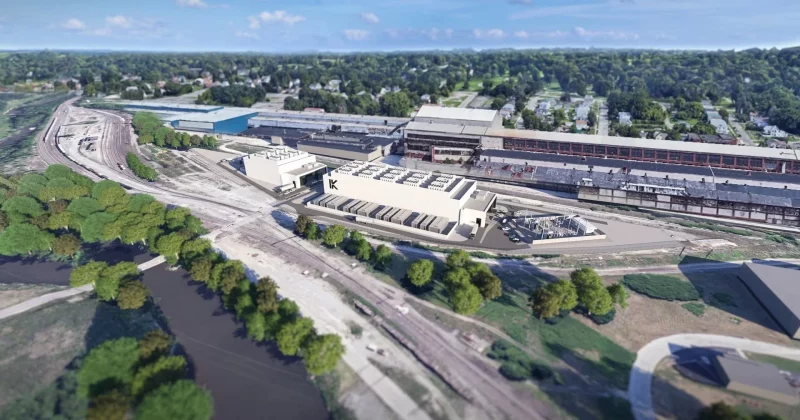
The Lake Mariner campus, located on the site of a former coal-fired power plant near Buffalo, New York, is being transformed into TeraWulf's core asset. The 168MW CB-4 building currently under construction is scheduled to begin power delivery in the third quarter of 2026, and the 160MW CB-5 lease expansion option signed with Fluidstack has already been exercised and is being prepared for operation. This facility modernization is a key process in converting TeraWulf's 2.3GW HPC portfolio into a tangible source of revenue.
- Q3 2026: Power delivery and revenue generation scheduled to begin for the 168MW CB-4 building
- By the end of 2026: Delivery of the 160MW CB-5 leased facility with Fluidstack
- Continued phased introduction of Schneider Electric's $290 million AI infrastructure solutions
- 2027: Target for turning EPS positive and achieving annual profitability
On the financial side, TeraWulf is moving away from the volatility of mining revenue toward a predictable HPC recurring revenue structure. While Q1 2026 results were below expectations, the surge in revenue in the HPC sector is interpreted as a positive signal. The market expects TeraWulf to gradually narrow its losses, recording an EPS of -$0.24 in Q2 2026 and -$0.14 in Q3 2026. The fact that it secured approximately $13 billion in contracted revenue as of early 2026 is expected to be a strong foundation for future profitability improvement.
In conclusion, TeraWulf is leading the digital energy revolution by successfully integrating the power management expertise gained from Bitcoin mining into AI infrastructure. With approximately 50% of analysts maintaining a 'Buy' rating on TeraWulf, the operation of the CB-4 facility scheduled for the second half of 2026 is expected to be a decisive catalyst for a re-evaluation of the company's value. TeraWulf is preparing to leap forward as a key infrastructure company connecting AI economic sovereignty and energy security beyond simple power supply.

This content is for information and commentary only and is not investment advice.
Join the reader conversation
Read reactions to this article and leave your own note.