Gap Between Vision and Reality: Robinhood Chain's Initial Success Driven by Memecoin Craze Instead of Tokenized Stocks
Launched on July 1, 2026, Robinhood Chain is recording explosive initial growth driven by trading of memecoins like 'Tendies' and 'CASHCAT' instead of its original goal of tokenized stocks.
When Robinhood Chain officially launched on July 1, 2026, the market expected a sophisticated financial innovation where Wall Street assets would migrate en masse to an Arbitrum-based Layer 2. However, data from the first two weeks after launch shows a completely different pattern. Retail investors showed almost no interest in tokenized stocks like Apple, instead immersing themselves in high-risk memecoin trading like 'Tendies' and 'CASHCAT', causing network transaction volume to skyrocket.
Robinhood Chain traders are choosing Tendies over Apple stock.
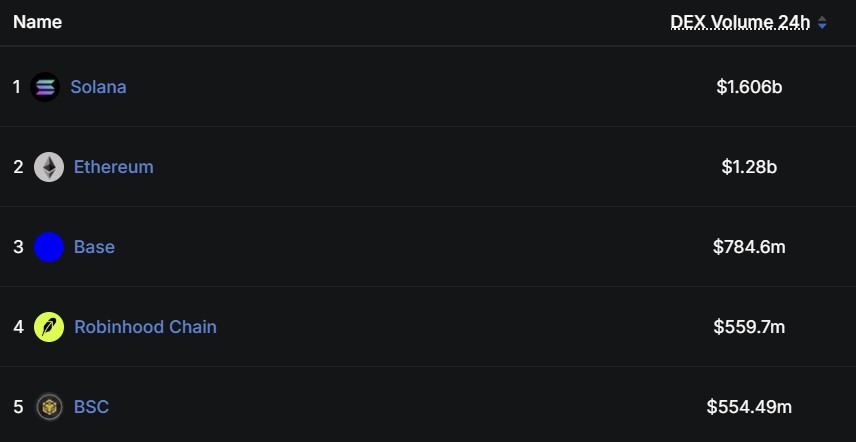
Immediately after its technical launch, Robinhood Chain made a spectacular debut, surpassing $500 million in 24-hour decentralized exchange (DEX) trading volume. This temporarily exceeded Hyperliquid's performance and approached nearly one-third of Solana's spot trading volume. On the first day alone, 141,000 wallets were activated, breaking metrics that new blockchains typically take months to achieve in just seven days.
Stark Data Gap Between Memecoins and Tokenized Stocks
The Real World Asset (RWA)-based tokenized stocks ambitiously launched by Robinhood are showing poor performance, overshadowed by the momentum of memecoins. As of early July 2026, the liquidity of major tokenized stocks such as USA Rare Earth and Bloom Energy remains below $400,000 each. Compared to the memecoin market where hundreds of millions of dollars are traded, the adoption rate of institutional-grade assets is significantly slower.
- USA Rare Earth Token: Liquidity approx. $397,700
- Bloom Energy Token: Liquidity approx. $372,400
- United States Oil Fund Token: Liquidity approx. $366,700
This memecoin craze was further accelerated by integration with external platforms. On July 8, 2026, the memecoin issuance platform Pump.fun began supporting Robinhood Chain tokens, starting to absorb trading demand from Solana. In particular, the prediction market project 'World,' which had launched on Solana, made a surprise move to Robinhood Chain in the same week, fueling the influx of retail investors.
Analysts define Robinhood Chain's first-week performance as the '26-to-1 liquidity paradox.' This refers to the phenomenon of generating $570 million in trading volume with only $21 million in liquidity. Conversely, this high capital efficiency proves that the assets currently dominating the network are extremely speculative and volatile.
While memecoins drive trading volume, the network's capital base is supported by stablecoins. As of July 8, 2026, the Total Value Locked (TVL) of Robinhood Chain surpassed $100 million. This is mainly due to yield-seeking stablecoin deposits, showing that real capital is accumulating within the network independently of speculative trading.
However, this speculative pattern risks clashing with Robinhood's regulatory compliance stance. On March 11, 2026, the U.S. Securities and Exchange Commission (SEC) and the Commodity Futures Trading Commission (CFTC) signed a Memorandum of Understanding (MOU) to strengthen joint oversight of virtual assets. The possibility that the indiscriminate issuance and trading of memecoins on Robinhood Chain will become a target for regulatory authorities in the future cannot be ruled out.
It remains to be seen whether Robinhood Chain can shed its initial image as a 'memecoin-only chain' and transform into its original goal: a hub for the tokenization of traditional stocks. A key point to watch is whether the current retail finance momentum will serve as an early bootstrap stage for expanding the network ecosystem or become an obstacle to the entry of institutional investors. Robinhood faces the challenge of converting the speculative craze into the stability of institutional finance.



This content is for information and commentary only and is not investment advice.
Join the reader conversation
Read reactions to this article and leave your own note.