Visa Significantly Expands Stablecoin Payment Infrastructure by Adding 5 Blockchains Including Base and Polygon
On April 29, 2026, Visa accelerates blockchain-based financial innovation by integrating five networks, including Base and Polygon, into its stablecoin payment program. The program currently shows a 50% quarterly growth rate and has achieved an annual run rate of $7 billion.
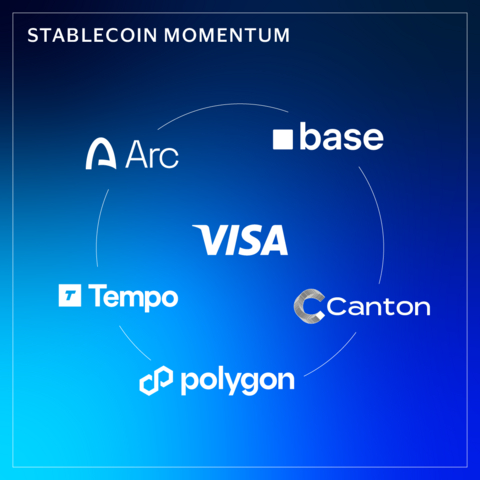
On April 29, 2026, global payments giant Visa announced the integration of five new networks—Base, Polygon, Canton, Arc, and Tempo—into its global stablecoin payment infrastructure. This expansion is seen as a significant milestone in Visa's transition into a blockchain-native payments company, particularly as the pilot program's annual run rate reached $7 billion.
Through this move, Visa has significantly broadened its support range, from Ethereum Layer 2 solutions like Base and Polygon to institution-focused blockchains like Canton. This suggests that cryptocurrency integration has moved beyond a mere experimental phase to become a pillar of Visa's core global payment strategy.
Visa's stablecoin payment program is recording steep growth, with transaction volumes doubling over the past six months. Compared to an annual payment volume of $3.5 billion as of December 16, 2025, the current run rate of $7 billion as of April 2026 reflects a record quarterly growth rate of approximately 50%.
Beyond simple fund movement, Visa is building an intelligent layer that analyzes on-chain data and provides business intelligence for its global payment partners.
This expansion is noteworthy for taking a hybrid approach that encompasses both public and institutional blockchains. While Base and Polygon provide scalability for mainstream transactions, Canton is designed as a private network for financial institutions, aiming to merge institutional finance with decentralized finance (DeFi).
Strategic Combination of Public Layer 2 and Institutional Blockchains
The networks selected by Visa serve different strategic purposes. The Canton network is a privacy-preserving Layer 1 blockchain that helps financial institutions perform interoperable transactions while maintaining security and regulatory compliance. On the other hand, Base and Polygon focus on increasing consumer-centric payment speeds by leveraging the liquidity of the Ethereum ecosystem.
- Base and Polygon: Providing scalability and mainstream accessibility based on Ethereum Layer 2
- Canton and Arc: Specialized in security and privacy for institutional-grade financial transactions
- Tempo: Integration of a dedicated network to increase global payment efficiency
- Growth Metrics: Achieved 50% quarterly growth and a $7 billion run rate as of April 2026
This expansion of backend infrastructure is closely linked to consumer-facing card programs. On March 3, 2026, Visa announced plans to expand its partnership with Bridge, a stablecoin infrastructure platform, to launch stablecoin-linked cards in over 100 countries worldwide. This is an attempt to naturally integrate complex blockchain technology into the card payment environment used by general consumers.
According to recent data from Forbes, on-chain stablecoin transaction volume reached $33 trillion in 2025, surpassing the combined payment volume of Visa and Mastercard ($25.5 trillion). Visa's aggressive network expansion is interpreted as a strategic choice to respond to these massive market shifts and supplement the limitations of traditional card payment networks with the new rails of stablecoins.
Advancement of On-chain Analysis and Future Payment Infrastructure
From a technical standpoint, Visa is not just moving assets but is also integrating real-time on-chain analysis tools to precisely monitor payment flows. This intelligent infrastructure provides transparency to global financial partners and supports stablecoins as a potential alternative to traditional financial systems.
The multi-chain expansion strategy announced on April 29, 2026, will allow Visa to maintain its status as a key intermediary in an era where stablecoins become a major payment asset. As the era of utility-driven digital payments begins in earnest, Visa's blockchain infrastructure is expected to become even more robust.
In conclusion, Visa aims to secure leadership in the future payment market by embracing both public and institutional blockchains. The addition of these five networks is more than a simple technical update; it is a powerful signal that the global financial system is moving toward a blockchain-based real-time settlement system.


This content is for information and commentary only and is not investment advice.
Join the reader conversation
Read reactions to this article and leave your own note.