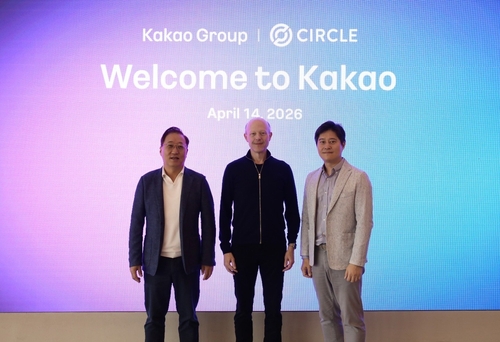
Kakao and Toss Form 'KRW Stablecoin' Alliance with Global Firm Circle to Accelerate Digital Financial Infrastructure Innovation
On July 23, 2026, domestic fintech giants Kakao and Toss signed a strategic partnership with global stablecoin issuer Circle to build a KRW-based digital asset infrastructure. This collaboration aims to create a next-generation financial ecosystem encompassing payments, remittances, and settlements.
On July 23, 2026, Korea's leading fintech companies, Kakao and Toss, officially announced a strategic partnership with Circle, the issuer of the world's second-largest stablecoin, USDC, to build a KRW-based stablecoin infrastructure. This collaboration is a concrete result achieved about three months after Circle CEO Jeremy Allaire visited the Kakao Pay office in Pangyo to begin discussions with heads of major domestic financial platforms last April.
Circle is a company that has established a strong position in the global market by market capitalization and has emphasized transparency through regular proof-of-reserve disclosures and regulatory compliance. Kakao and Toss aim to open a new era in which blockchain-based payment and remittance systems are integrated into daily financial life by applying Circle's global operational expertise to the domestic financial environment.
A large number of core subsidiaries from both fintech groups, including KakaoBank, Kakao Pay, Toss Bank, and Toss Payments, are participating in this partnership. They plan to utilize Circle's technical protocols to review the issuance and distribution system for digital assets pegged to the value of the Korean Won and jointly develop innovative financial services using them.
This collaboration will be a turning point where payment, remittance, and settlement systems based on blockchain technology are deeply integrated into the daily financial lives of Koreans.
Substantive discussions for the project began in Pangyo in April 2026. At the time, CEO Jeremy Allaire met with KakaoBank CEO Yun Ho-young and Kakao Pay CEO Shin Won-keun to share a long-term roadmap for building a digital asset ecosystem. This meeting went beyond simple technical exchange and led to a practical agreement to build a stablecoin infrastructure optimized for the Korean market.
Core Objectives of Digital Financial Innovation and Regulatory Response
The core of the collaboration lies in creating a comprehensive digital financial infrastructure that encompasses payments, remittances, and settlements. Both parties plan to build a system that can move funds faster and at a lower cost than existing financial networks by utilizing KRW-pegged stablecoins, and to maximize the efficiency of B2B transactions by introducing automated settlement processes through smart contracts.
- Building a next-generation blockchain-based digital payment system
- Enhancing efficiency and reducing costs for domestic and international remittance services
- Introducing automated settlement processes using smart contracts
- Jointly reviewing the marketability of tokenized financial services and KRW digital assets
These moves are in line with the domestic virtual asset regulatory environment that is becoming more concrete in 2026. The Korean financial authorities are pushing for a plan to introduce the Basel Committee on Banking Supervision (BCBS) prudential regulatory standards for crypto-assets to fit the domestic situation, which is expected to serve as a key foundation for providing a legal basis for the banking sector's issuance of and participation in stablecoins.
On the same day, July 23, 2026, news broke that Mirae Asset had completed its acquisition of the virtual asset exchange Korbit, further accelerating the entry of the domestic financial sector into the virtual asset market. Mirae Asset's announcement of plans to increase its stake in Korbit to 97.15% suggests that the competition among institutional financial firms to secure virtual asset infrastructure has entered a full-scale phase.
Security Risk Management and Future Outlook
However, concerns regarding technical security and price stability remain challenges to be addressed. The $24 million asset outflow incident at Arbitrum-based AFX Trade, reported on July 23, 2026, clearly demonstrates the vulnerabilities of bridge security. Therefore, for KRW-pegged stablecoins to successfully settle into the market, a highly sophisticated security system capable of preventing de-pegging risks, along with transparent management of reserves, is essential.
In conclusion, this alliance between Kakao, Toss, and Circle is expected to serve as an opportunity to redefine the efficiency of the Korean financial system as it heads toward 2027. The transition to a 'Programmable Economy' will be completed on the two pillars of regulatory approval and user trust, and this infrastructure construction project is expected to be a crucial test bed for that transition.

This content is for information and commentary only and is not investment advice.
Join the reader conversation
Read reactions to this article and leave your own note.