[Analysis] The Great Shift Brought by the 2026 World Cup: Prediction Market Monthly Trading Volume Reaches $50 Billion
Just one month after the opening of the 2026 FIFA World Cup, the monthly trading volume of global prediction markets surpassed $50 billion, marking a historic milestone. This is evaluated as a structural shift shaking the landscape of the traditional sports betting industry.
On July 14, 2026, the prediction market industry reached a historic watershed of $50 billion in monthly trading volume, driven by the explosive popularity of the 2026 FIFA World Cup. This record-breaking figure signifies a fundamental change in how users worldwide hedge and speculate on real-life events, going beyond a simple betting craze. Decentralized platforms are now directly challenging the dominance of traditional sports betting operators.
As of July 14, 2026, the monthly trading volume of prediction markets exceeded $50 billion, marking a 'breakout' moment that surpassed market expectations. This scale of adoption, significantly exceeding initial projections, suggests that crypto-based prediction platforms have established themselves as mainstream financial services. This is a level of achievement that was difficult to imagine back in 2024.
With this World Cup as a catalyst, prediction markets have achieved massive growth, overwhelming traditional sports betting operators.
The extensive reach and match structure of the 2026 World Cup served as an engine supplying the massive liquidity needed for prediction markets to expand. As a global betting craze flowed in, market depth reached unprecedented levels. This became a turning point that led even institutional investors to pay attention to the data efficiency of prediction markets, moving beyond simple speculative capital.
Performance of Major Platforms: Polymarket, Kalshi, Rotera
In terms of market share, the performance of major platforms such as Polymarket and Kalshi was prominent. In particular, Polymarket drove trading volume by operating large-scale reward programs to maximize user participation. Each platform is dividing the market through different regulatory environments and marketing strategies.
- Polymarket: Monopolized global traffic by offering up to $2 million in prize money through the 'Perfect Bracket' contest.
- Rothera: Secured a 7% market share in the U.S. by recording a notional trading volume of approximately $2 billion in the U.S. market.
- Kalshi: Absorbed institutional and individual investors by supporting legal derivative trading in the U.S. based on CFTC regulations.
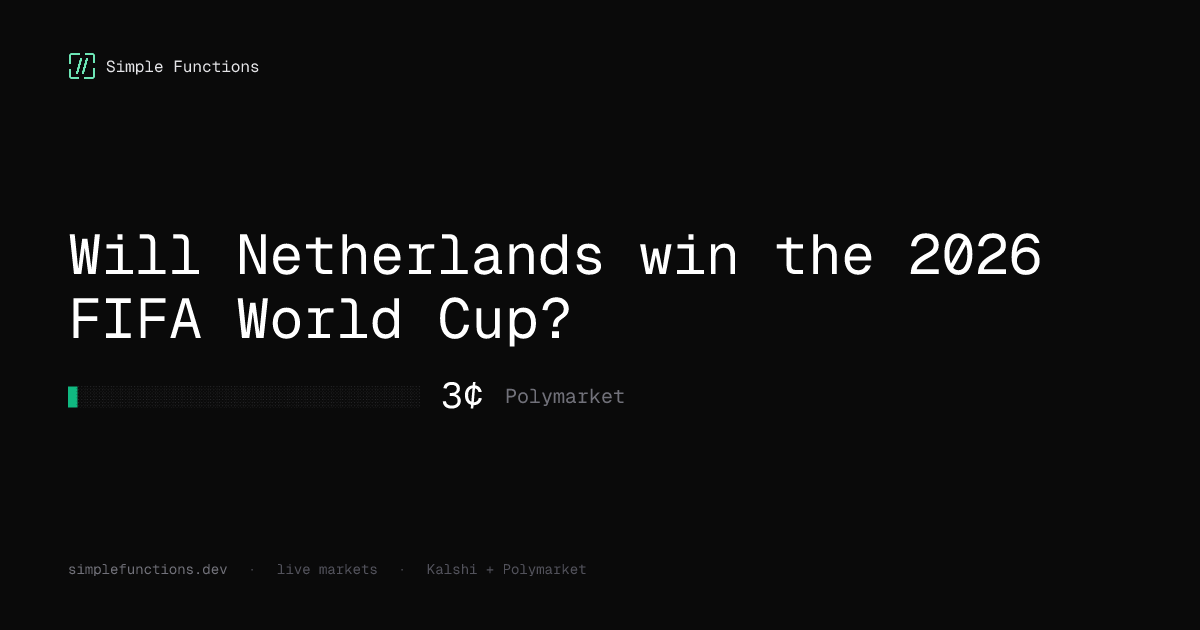
Looking at specific market examples, Brazil's probability of winning on Polymarket is set at 9%, trading at 9 cents per share. This figure is considered significantly undervalued compared to the historical status of Brazil, a five-time World Cup winner. On the other hand, the Netherlands' probability of winning is only 3%, classified as an extreme long-shot bet trading at 3 cents per share. These contracts are scheduled to expire on July 20, 2026, immediately after the World Cup final.
One of the main reasons prediction markets were able to overwhelm traditional sports betting companies is the regulatory advantage. Unlike traditional betting, where legal status is fragmented by state, platforms regulated by the CFTC have secured nationwide accessibility as financial derivatives. This structural difference has brought about a 'tectonic shift' from betting to trading, and users are now buying and selling World Cup results as sophisticated financial assets based on real-time data.
Historical Growth Trajectory and Future Outlook
Kalshi's trading volume, which was only $27 million during the 2024 Super Bowl, has grown to $1 billion in 2026, drawing an explosive trajectory. Over the past two years, prediction markets have recorded growth rates of thousands of percent annually, emerging from a simple niche market to a core pillar of global finance. This growth was a precursor to the $50 billion milestone achieved in this World Cup.
After the massive expiration of World Cup-related contracts on July 20, 2026, where this enormous liquidity will head is a key point to watch. Industry experts believe that funds secured from sports will migrate to political and economic prediction markets. Surpassing the $50 billion mark has proven that prediction markets are the most powerful tool for measuring the efficiency of real-time information, and this growth trend is expected to expand into areas such as global macroeconomic indicator forecasting even after the World Cup ends.
| Team | Prediction Market Price (per share) | Implied Probability |
|---|---|---|
| Brazil | 9¢ | 9% |
| Netherlands | 3¢ | 3% |
Market odds and implied probabilities for top contenders as of July 14, 2026.

This content is for information and commentary only and is not investment advice.
Join the reader conversation
Read reactions to this article and leave your own note.