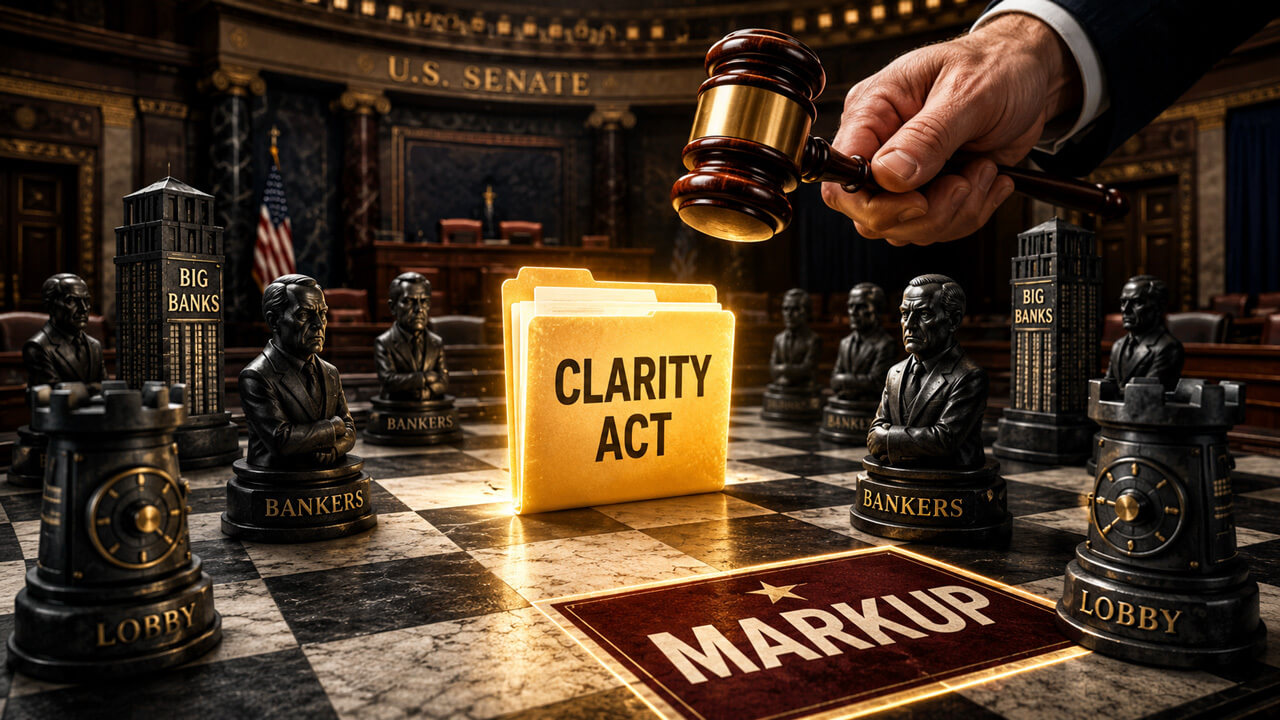
US Banking Sector Strongly Opposes Stablecoin Yield Compromise in CLARITY Act... Warns of "Regulatory Evasion Potential"
The US banking industry has moved to block legislation, warning that the latest compromise in the 'Clarity for Payment Stablecoins Act (CLARITY Act)' could become a loophole for regulatory evasion by allowing yield structures similar to bank deposits.
The US banking sector has expressed strong opposition to the latest compromise of the 'Clarity for Payment Stablecoins Act (CLARITY Act).' Major financial groups, including the American Bankers Association (ABA) and the Bank Policy Institute (BPI), warned in a joint statement on May 4, 2026, that the bill could provide stablecoin issuers with opportunities for regulatory evasion. They particularly emphasized that provisions related to stablecoin yields could threaten the deposit base of the existing banking system.
The latest proposal is not sufficient to protect bank deposits, and stablecoin reward programs could function as de facto deposit interest, leading to capital flight.
This controversy arose just as Senators expected the compromise reached last week to settle months of conflict over stablecoin regulation. With the bill's markup scheduled for the following week starting May 11, 2026, this move by banking lobby groups has emerged as a new variable in the legislative process. Industry analysts suggest that some factions within traditional finance are using the yield debate as a means to indefinitely delay the legislation itself rather than addressing policy flaws.
Ambiguity in Yield Regulations and Concerns Over Regulatory Gaps
The core issue pointed out by the banking sector is the definition of 'rewards' provided to users by stablecoin issuers. While the CLARITY Act prohibits direct interest payments similar to deposits for stablecoins, it allows rewards through loyalty programs or memberships. The banking sector argues that the fact these rewards can be calculated based on balance, holding period, and retention period makes them no different from actual interest payments, criticizing this as clear regulatory evasion.
- Joint response from major financial groups including the American Bankers Association (ABA) and the Bank Policy Institute (BPI)
- Possibility of stablecoin reward systems competing with bank deposit rates and causing 'Deposit Flight'
- Demands for the deletion or modification of yield payment provisions disguised as loyalty programs
President Donald Trump recently sent a warning message regarding the banking sector's moves to block the passage of the CLARITY Act. The Trump administration has maintained the position that clarifying stablecoin regulations is essential for US financial innovation and maintaining dollar hegemony. However, the banking sector counters that stablecoins pose a high risk of being exploited for money laundering or terrorism financing, and that the Anti-Money Laundering (AML) and sanctions compliance requirements published in the Federal Register do not possess the same level of rigor as those for banks.
According to stablecoin issuer compliance requirements announced in the Federal Register on April 10, 2026, stablecoins can be an attractive tool for illicit money laundering networks due to their ability to move large sums of money quickly. In particular, reports have continued regarding Chinese money laundering organizations using stablecoins to hide proceeds from digital asset investment scams, highlighting the need for strengthened regulation. The banking sector is expressing concern over the expansion of the stablecoin market while these risk factors remain unresolved.
Opinions are also divided within the legislature. According to Senate Amendment No. 2307 (S.Amdt.2307), federal regulators would have the authority to refer unauthorized issuers to the Department of Justice if they issue stablecoins. However, the banking sector believes that proactive regulatory consistency is more important than such post-hoc punishment, maintaining the position that stablecoin issuers should be subject to the same capital adequacy and depositor protection standards as banks.
Cryptocurrency industry analysts, including Alex Thorn, Head of Research at Galaxy, point out that the banking sector's pushback is not simply due to policy concerns. They view the traditional financial sector as using the stablecoin yield debate as a strategic tool to indefinitely delay the passage of the bill. The dominant analysis is that the background of the banking sector's aggressive lobbying is the fact that stablecoins could threaten the monopoly status of banks as payment systems.
The Senate markup session scheduled for the second week of May 2026 is expected to be a watershed moment determining the direction of the CLARITY Act. Currently, there is a tense standoff among Senators between those who wish to stick to the compromise reached last week and those who demand additional revisions to reflect the banking sector's concerns. The outcome of this meeting will be a decisive indicator of whether the CLARITY Act can enter the final legislative stage within this year.
The conflict between the banking sector and the cryptocurrency industry over stablecoin regulation is expanding beyond simple legal interpretation into a struggle for dominance over the future financial system. Amid the clash between legislative efforts to secure regulatory clarity and the interests of traditional banking to protect the existing financial order, the final form of the CLARITY Act is expected to determine the direction of the US digital asset market.



This content is for information and commentary only and is not investment advice.
Join the reader conversation
Read reactions to this article and leave your own note.