Kalshi's Legal Defeat: State Regulatory Barriers Persist Despite Federal Approval
As of July 10, 2026, U.S. prediction markets are transforming into a 'fragmented market' disconnected by region due to the exercise of state regulatory powers, despite victories at the federal level. Kalshi's recent legal defeat suggests that federal approval does not provide complete protection from state gambling laws, creating legal uncertainty for investors based on their place of residence.
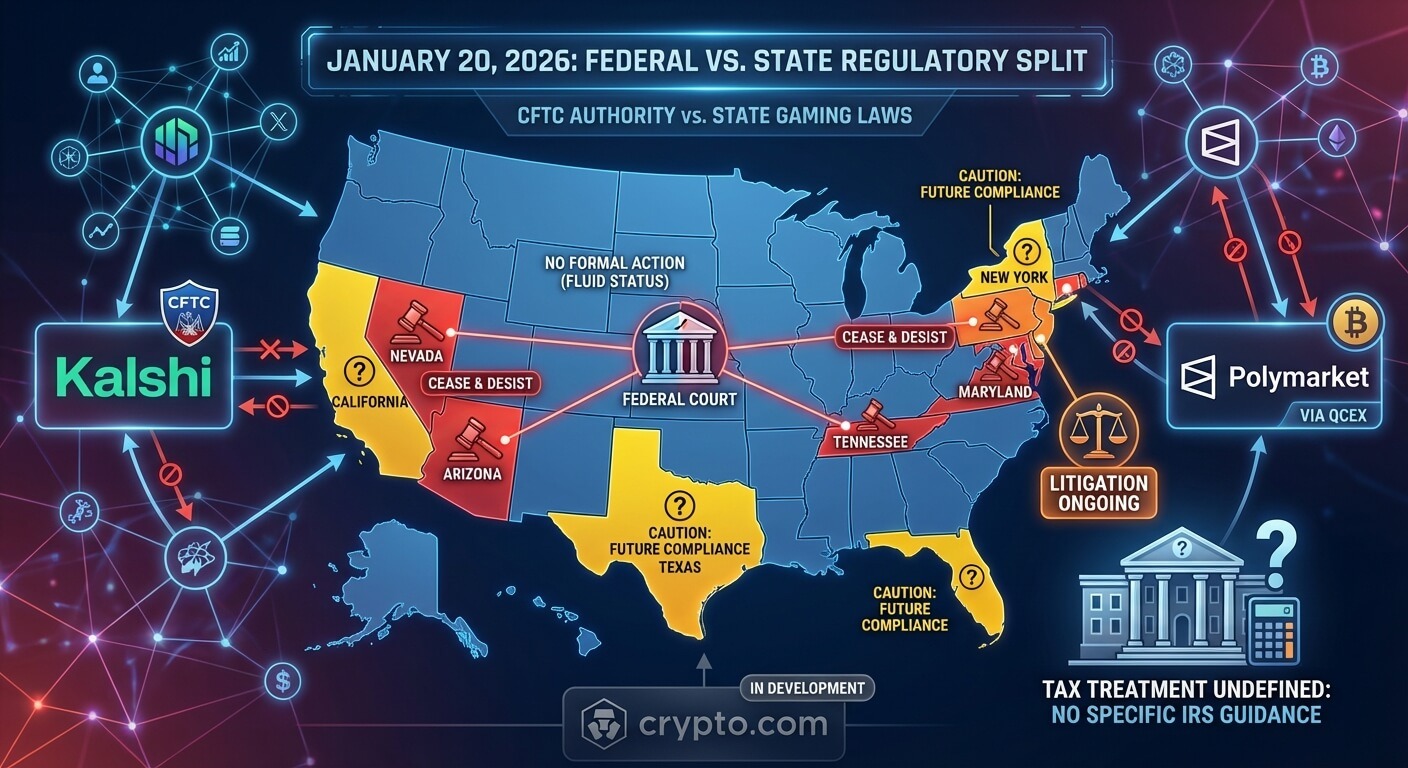
As of July 10, 2026, the journey toward establishing a unified prediction market in the United States has reached a significant legal crossroads. While Kalshi appeared to have laid the groundwork for national expansion with a landmark victory in federal court earlier this year, the market's fragmentation is accelerating following successive losses in legal disputes with major state governments, including New York and Maryland.
With the confirmation that approval from the Commodity Futures Trading Commission (CFTC) does not grant complete immunity from independent state regulatory enforcement, prediction markets are at risk of devolving into a 'zip-code-based market' where legality depends on the trader's place of residence. This jurisdictional conflict represents a direct confrontation between federal regulatory preemption and state police powers.
The enforcement action taken by New York State on July 9, 2026, provided a specific template for how state governments can bypass federal preemption to tighten regulations on sports events. Taking advantage of the gap where the CFTC has yet to finalize official national rules, the New York court opened the way for the state to exercise independent enforcement authority over sports event contracts. This clearly demonstrates the vulnerability that arises when federal regulatory oversight clashes with state-level gambling laws or sports betting regulations.
Federal court approval does not completely neutralize state police powers, and independent regulatory enforcement remains possible in certain states.
The Maryland case further supports this state authority. On August 1, 2025, Judge Adam B. Abelson denied Kalshi's motion for a preliminary injunction, ruling that the state gaming commission's authority can coexist with CFTC regulation. This ruling became a symbolic case showing that the Fourth Circuit Court of Appeals is not bound by industry-friendly rulings from other jurisdictions.
Judicial Split and the Victory of the Third Circuit Court of Appeals
In contrast, on April 6, 2026, the U.S. Court of Appeals for the Third Circuit ruled in a 2-1 decision that the Commodity Exchange Act (CEA) preempts state gambling laws in New Jersey, Pennsylvania, and Delaware. The court found that Kalshi's sports-related event contracts constitute 'swap' transactions under the CFTC's exclusive jurisdiction, but as the ruling's effect was limited to that specific jurisdiction, nationwide legal uncertainty was instead amplified.
- Tennessee (February 19, 2026): Ruled in favor of Kalshi by applying the principle of federal preemption.
- Kentucky (June 1, 2026): Established an economic barrier by imposing a 14.25% excise tax on event contracts.
- Federal Government Response (April 2, 2026): The CFTC and the Department of Justice filed lawsuits against Illinois, Connecticut, and Arizona to protect exclusive jurisdiction.
The federal government is launching a strong counter-offensive against these individual regulatory moves by state governments. On April 2, 2026, the U.S. government and the CFTC simultaneously filed lawsuits in federal courts in Illinois, Connecticut, and Arizona, requesting a reaffirmation of the CFTC's 'exclusive jurisdiction' over exchange-traded derivatives. This demonstrates the federal government's commitment to protecting prediction markets as financial products rather than gambling.
State government interference is extending beyond legal prohibitions to economic friction such as taxation. The 14.25% excise tax implemented by Kentucky on June 1, 2026, acts as a practical barrier to trading without directly closing the market, and a coalition of Kalshi and Polymarket is strongly pushing back by filing a lawsuit in federal court. These tax barriers are cited as a major factor hindering market liquidity.
Key variables that will determine the future direction of the market are the ruling of the U.S. Court of Appeals for the Ninth Circuit and the timing of the completion of the CFTC's final regulatory framework. The decision of the Ninth Circuit, which concluded oral arguments on April 16, 2026, is expected to reshape the market environment in the Western region, and the regulatory authority's final proposal is expected to provide clear guidelines for jurisdictional disputes with state governments.
In conclusion, although the U.S. prediction market has overcome the major hurdle of federal approval, it has encountered a new obstacle in the form of state-level 'patchwork regulation.' Until a final judgment from the Supreme Court or a clear legislative solution from Congress is provided, market participants, including Kalshi, will likely have to endure an unstable environment where the success or failure of their business depends on the legal interpretations of individual states.



This content is for information and commentary only and is not investment advice.
Join the reader conversation
Read reactions to this article and leave your own note.