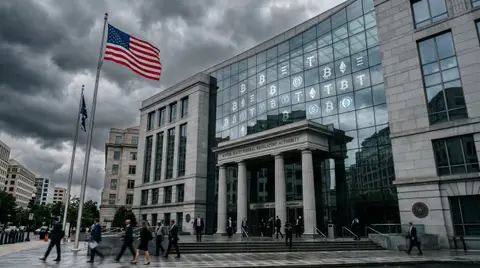
Crypto Exchanges Becoming a New Distribution Channel for Wall Street Assets: The July 2026 Turning Point
In July 2026, the launch of DTCC's tokenized securities pilot and the achievement of regulatory clarity are accelerating structural changes in the financial ecosystem as traditional financial assets migrate en masse to crypto exchanges.
As of July 14, 2026, the boundary between Wall Street and the cryptocurrency ecosystem has virtually vanished. This month, as the Depository Trust & Clearing Corporation (DTCC) fully launched its tokenized securities pilot and tokenized assets became the most listed category on major centralized exchanges (CEXs), global financial infrastructure has begun a full-scale migration to the blockchain.
The DTCC, the world's largest depository institution managing $114 trillion in securities, began operating a tokenized securities pilot this July targeting Russell 1000 index components, major ETFs, and U.S. Treasuries. This pilot includes limited production trading in a live environment and is considered the final testing phase ahead of the full system implementation scheduled for October 2026.
The replacement of traditional securities infrastructure with blockchain-based distribution channels is no longer a hypothesis, but a reality.
Behind these changes lie decisive regulatory advancements made in the first half of 2026. On March 17, the U.S. Securities and Exchange Commission (SEC) and the Commodity Futures Trading Commission (CFTC) released a joint interpretive framework, classifying 16 cryptocurrency assets, including Bitcoin and Ethereum, as digital commodities, putting an end to over a decade of security status controversies.
Regulatory Clarity and the $34 Billion RWA Market
The passage of the GENIUS Act and the CLARITY Act established a legal foundation for institutional investors to enter the market with confidence. In particular, the CLARITY Act clarified the definition of digital commodities and organized regulatory jurisdictions, contributing to the legalization of the path through which Wall Street assets are delivered to retail investors via new distribution networks called cryptocurrency exchanges.
- As of May 2026, the tokenized asset market size (excluding stablecoins) surpassed $30 billion
- As of the end of Q2 2026, the total Real World Asset (RWA) market size reached approximately $34 billion
- RWA assets based on the XRP Ledger (XRPL) surged from $991 million at the beginning of the year to $3.5 billion
Despite overall cryptocurrency market trading volume hitting a two-year low in the second quarter of 2026, tokenized stocks and RWA-linked products showed exceptional growth. Platforms such as Bitget's 'Stocks 2.0' have become key access points for retail investors seeking exposure to traditional stocks, reaching a level that threatens the market share of existing brokerage systems.
BlackRock's 'BUIDL' fund is considered a leader in this institution-led distribution innovation. Managing approximately $2.4 billion in assets, the fund invests in U.S. Treasuries and repurchase agreements (repos), drastically reducing traditional brokerage procedures and costs by distributing generated returns directly to token holders' wallets daily.
Revolution in Settlement Efficiency: From Days to Just Seconds
The technical advantages are even clearer. In a cross-border treasury redemption test based on XRPL last May, involving JPMorgan, Ripple, Mastercard, and Ondo Finance, settlement times were reduced to less than 5 seconds. This was recorded as a case that drastically reduced the multi-day settlement period required by existing financial systems.
However, risks associated with rapid migration also exist. Competition for leadership in regulatory standards between the U.S. and the U.K. could lead to global market fragmentation, and the dispersion of liquidity across multiple chains and platforms is pointed out as a factor that could hinder market efficiency. In particular, the regulatory gap between Washington and London is expected to be a major issue in the future global standard-setting process.
The Journey Toward Full Implementation in October
In the second half of 2026, the market's attention is now focused on the full-scale rollout of DTCC's tokenized securities, scheduled for October. Once large-scale real assets begin to circulate on the blockchain beyond the pilot phase, cryptocurrency exchanges are expected to fully establish themselves as the primary distribution channel for all financial assets worldwide, moving beyond being mere trading venues for virtual assets.
This content is for information and commentary only and is not investment advice.
Join the reader conversation
Read reactions to this article and leave your own note.