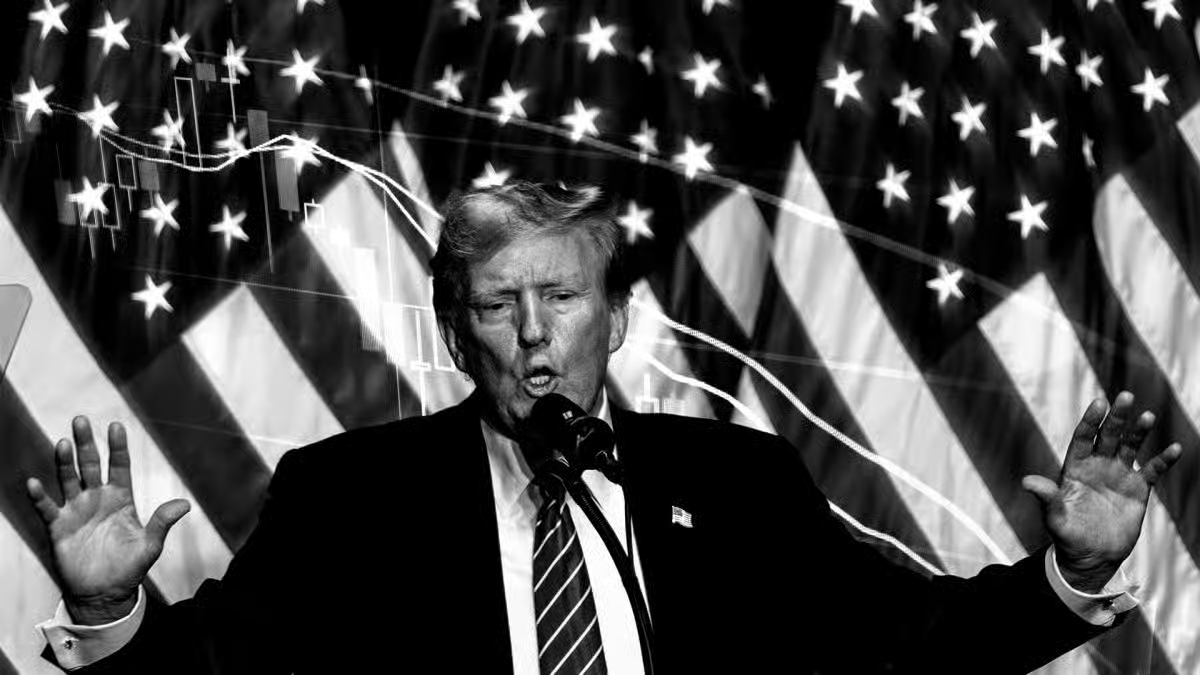
[Analysis] Clash Between President Trump and Senate Over 'CLARITY Act': Ethics Provisions in Crypto Regulation Emerge as Key Issue
On July 16, 2026, President Trump meets with senators to push for the removal of ethics provisions from the CLARITY Act (Crypto-Asset Market Clarity Act). With the goal of passing the bill before the August recess, the conflict between the executive and legislative branches over conflict-of-interest regulations is intensifying.
On July 16, 2026, a critical meeting that will determine the fate of the CLARITY Act (Crypto-Asset Market Clarity Act) will be held at the White House. President Donald Trump is scheduled to meet with key senators to reconcile deep disagreements over ethics provisions within the bill. As the August congressional recess approaches, the President is pushing for the passage of the bill with the ethics regulations removed, while a bipartisan group of lawmakers maintains that conflict-of-interest rules are essential for the bill's legitimacy.
The Senate must immediately pass the CLARITY Act after removing unnecessary ethics provisions that hinder the development of the crypto-asset industry.
This meeting is seen as the final hurdle for the bill's passage. President Trump signaled the start of negotiations on the previous day, July 15, 2026, by publicly demanding on his social media platform, Truth Social, that the Senate process the bill without the ethics provisions. This pressure from the administration is interpreted as an attempt to expedite the bill's processing, but caution remains significant within Congress.
White House Summit: The Showdown on July 16
As of the early hours of July 16, 2026, tension is palpable around the White House. Through this meeting, President Trump is expected to solidify the unity of Republican lawmakers while strongly pressuring Democrats who are lukewarm about the bill's passage. The President's public remarks suggest that these negotiations will be a stage to test the administration's legislative control beyond mere policy coordination.
- Whether to prohibit high-ranking public officials from engaging in virtual asset-related business activities
- The scope of application of conflict-of-interest prevention regulations for the President and Vice President
- Shortening the legislative schedule for bill processing before the August recess
- The level of strengthening Anti-Money Laundering (AML) regulations
The ethics clause at the center of the controversy strictly limits high-ranking public officials from directly operating virtual asset companies or taking related profits. The core objective is to prevent key executive branch figures, including the President and Vice President, from using information obtained during the legislative process for private gain. President Trump's side argues that these regulations are excessive and hinder industrial development, while supporters counter that they are non-negotiable provisions for ensuring fairness.
Democrats, led by Senator Elizabeth Warren, warn that the credibility of the entire bill will plummet if the ethics clause is removed. Senator Warren made it clear in a recent statement that the virtual asset bill should not be used as a means of wealth accumulation for specific politicians or their families. She maintains a firm stance that she will not cooperate with the processing of the bill unless strong conflict-of-interest prevention measures are in place before the Senate floor vote.
Legislative Journey: From Committee to the Floor
The CLARITY Act has already undergone a legislative process of more than a year. After the House Financial Services Committee and the Agriculture Committee reported H.R. 3633 on June 23, 2025, it was passed by the Senate Banking Committee on May 14, 2026, with 15 votes in favor and 9 against. At the time, all 13 Republican members voted in favor, but only two Democrats voted in favor, and even they attached the condition that further agreement on the ethics clause was necessary.
The market and industry are focusing on the deadline of the August recess. If no breakthrough is made at the meeting on July 16, 2026, and the processing of the bill is pushed back to after September, regulatory uncertainty in the virtual asset market is expected to reach its peak. Industry officials are urging a swift agreement, expressing concern over market volatility and investor confusion that could occur without regulatory clarity.
In addition to the ethics clause, disagreements remain regarding Anti-Money Laundering (AML) regulations and the strengthening of law enforcement tools. The issue of granting investigative agencies stronger authority to track illegal fund flows through virtual assets is another point of contention. Although overshadowed by the ethics debate, AML regulations, which are directly linked to national security, also remain a task that must be resolved for the final agreement on the bill.
Ultimately, the White House summit on July 16, 2026, is expected to be a watershed moment between compromise and stalemate. Whether the President's strong pressure leads to the passage of a bill with the ethics clause removed, or whether the Democrats' demands are accepted and stricter conflict-of-interest prevention measures are established, will determine the future landscape of virtual asset regulation. With both sides holding firm, the outcome of this meeting is expected to be a decisive moment that determines the direction of U.S. virtual asset policy.



This content is for information and commentary only and is not investment advice.
Join the reader conversation
Read reactions to this article and leave your own note.