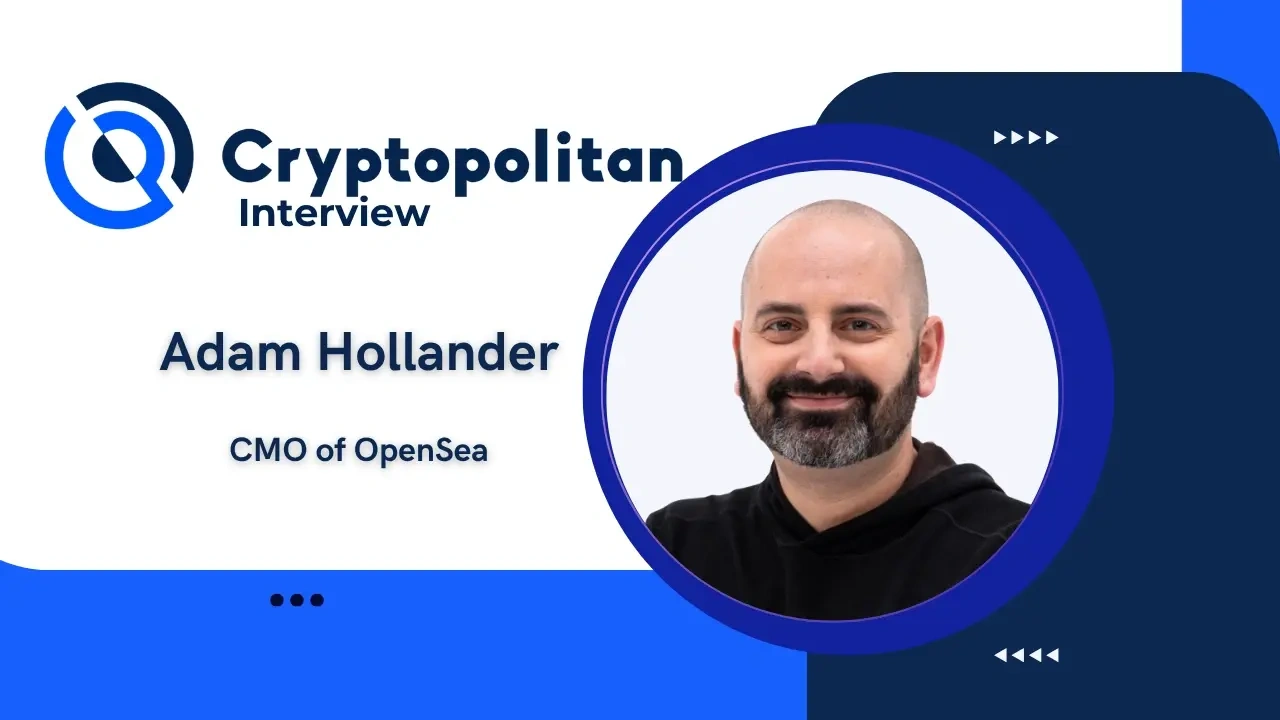
OpenSea CMO Adam Hollander Announces Strategic Shift Toward Real-World Asset-Based 'Phygital' NFTs
OpenSea CMO Adam Hollander predicted at Consensus Miami 2026 that real-world asset-based 'phygital' NFTs will become the market's new driving force.
At the Consensus conference held in Miami on May 8, 2026, Adam Hollander, Chief Marketing Officer (CMO) of OpenSea, the world's largest NFT marketplace, declared a paradigm shift in the NFT market. He emphasized that beyond the era of speculative digital art in the past, NFTs based on real-world assets (RWA) such as Pokemon cards, Rolex watches, and event tickets will be the next growth engine. This change aligns with the market trend where the trading volume of 'phygital' NFTs, which combine physical and digital elements, surged by 60% in 2026.
OpenSea will not remain just a place that remembers the NFT boom of 2021. We are evolving into a multi-asset hub that provides clear value to collectors through the tokenization of real-world assets.
On the Consensus stage, CMO Hollander made it clear that OpenSea is moving away from its past reputation as a mere 'JPEG' exchange. He specifically mentioned the tokenization of Pokemon cards, which is gaining popularity on platforms like Courtyard, explaining that these real-world-based assets reduce risk through clear physical value backing even in a bear market. This strategy reflects the trend as of May 2026, where investors prioritize utility and actual ownership over simple speculation.
The Combination of Real-World Assets and Digital: The Rise of the 'Phygital' Economy
In 2026, the NFT market reached a scale of approximately $60.82 billion, with the phygital sector showing the steepest growth. The method of trading luxury watches like Rolex or rare collectibles like Pokemon cards by tokenizing them on the blockchain has dramatically simplified authenticity verification and ownership transfer. This 'digital twin' model has established itself as a new commercial standard in the luxury goods market, serving as a certificate of authenticity and a lifecycle passport.
- Collectibles such as rare Pokémon cards: Tokenization through specialized platforms like Courtyard and the formation of an active secondary market
- Luxury watches including Rolex: Used as assets symbolizing both digital and physical status
- Utility-based event tickets: Tokenized ticketing ensuring anti-counterfeiting and resale transparency
From a technical perspective, the advancement of Artificial Intelligence (AI) is acting as a key factor in lowering the entry barriers for such tokenization. CMO Hollander analyzed that AI is helping creators and brands issue innovative tokenized assets more easily. As AI-based automated inspection and token generation tools become widespread by mid-2026, cases of general companies linking their physical products with NFTs are surging.
OpenSea is now moving beyond being a simple NFT marketplace and is pursuing a 'One App' strategy that encompasses meme coins, perpetuals (perpetual futures), and major cryptocurrencies. Hollander stated that OpenSea aims to become the hub for all digital asset transactions. Although recent rumors of a $150 million 'SEA' token pre-sale on Coinbase were found to be groundless, OpenSea reaffirmed that the launch plan for SEA, a native token dedicated to the ecosystem, is included in the roadmap.
Evolution of the Platform and Long-term Outlook for 2034
Market analysts project that the NFT sector will record a compound annual growth rate (CAGR) of 23.7% from 2026 to 2034. While OpenSea faces the challenge of competing with RWA-dedicated platforms targeting niche markets, it seeks to maintain market dominance through its extensive user base and integrated app strategy. In particular, utility-centered differentiation is accelerating, with music NFTs recording $520 million in revenue and carbon credit NFTs growing to a scale of $300 million.
In conclusion, OpenSea's recent strategy shift suggests that NFTs have evolved beyond simple digital collectibles into tools that enhance the efficiency of the real economy. The vision presented by CMO Adam Hollander accurately captures the market situation of 2026, where blockchain technology permeates as a core infrastructure for everyday asset management such as luxury goods, collectibles, and ticketing. OpenSea is expected to build a more powerful integrated trading environment with the future launch of the SEA token.


This content is for information and commentary only and is not investment advice.
Join the reader conversation
Read reactions to this article and leave your own note.