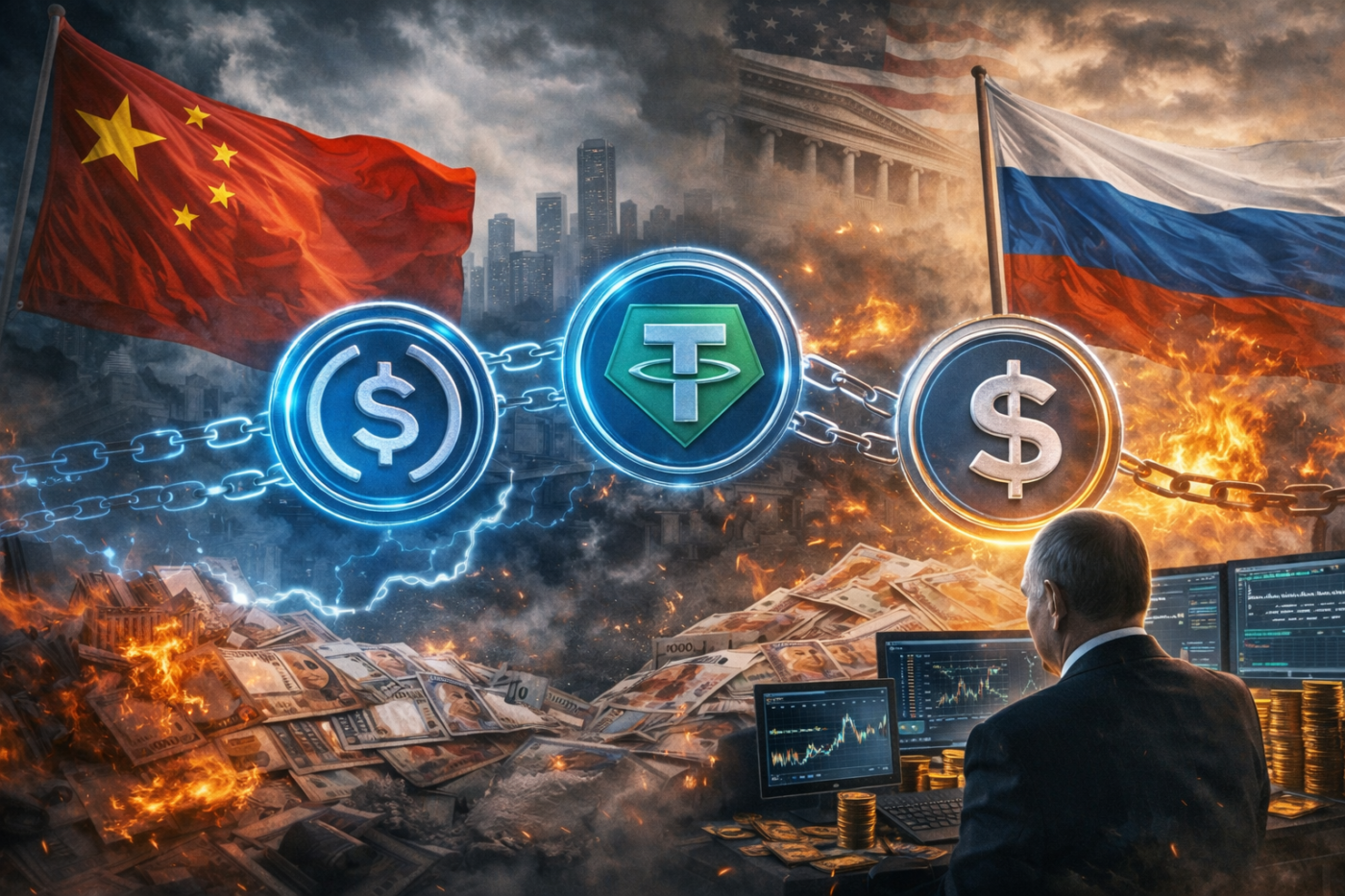
Beyond Sanctions Evasion to Financial Infrastructure: Analysis of Russian Stablecoin A7A5's Market Dominance and Post-Sanctions Strategy
Despite the European Union's (EU) strong sanctions on the cryptocurrency sector, the Russia-linked stablecoin A7A5 is emerging as a key payment method in the Eurasian region, processing $100 billion in transactions.
While the European Union (EU) implements its strongest-ever sanctions targeting cryptocurrencies, the Russia-linked stablecoin A7A5 is putting forward an independent survival strategy that goes beyond sanctions evasion. Supporters of the token, which surpassed $100 billion in cumulative on-chain transaction volume as of January 2026, argue that it will remain a permanent component of Eurasian finance due to its fast settlement speeds and regional infrastructure, even if geopolitical tensions ease.
By January 2026, just one year after its launch, A7A5 surpassed $100 billion in cumulative on-chain transaction volume, becoming the world's largest non-dollar stablecoin.
As of January 2026, A7A5 has seen approximately 250,000 transfers across more than 41,000 accounts, showing particularly high adoption rates in the Russian and Kyrgyz markets. The core of this system is an 'industrial-scale' infrastructure based on cooperation between the Kyrgyz issuer, Old Vector, and the Russian state-owned bank, Promsvyazbank. A7A5 operates based on deposits in Russian banks and is subject to Kyrgyz financial regulations, a structure that allows it to evade Western surveillance.
EU's 20th Sanctions Package: Total Ban on the Cryptocurrency Sector
Through the 20th sanctions package announced in April 2026, the European Union has moved to exert total pressure on the Russia-linked cryptocurrency ecosystem. This measure goes beyond the previous method of listing specific individuals or companies, introducing a 'sector-wide total ban' targeting all Russia-based cryptocurrency service providers and decentralized platforms. Previously, in the 19th package, restrictions were also imposed on A7A5 and its related companies, Old Vector and Grinex.
- Introduction of a comprehensive sectoral ban on Russia-based cryptocurrency service providers
- Targeting categories of sanctions evasion infrastructure, including decentralized finance (DeFi) platforms
- Strengthening regulations on A7A5 issuer Old Vector and the related exchange Greenex
- Strict restrictions on European financial institutions handling Russia-linked digital assets
Despite this external pressure, A7A5 is redefining the nature of its asset from a means of sanctions evasion to financial innovation. They emphasize trade settlement speeds and yields faster than the existing SWIFT system, arguing that even if geopolitical tensions ease and sanctions are lifted in the future, it will maintain competitiveness as a superior alternative for regional trade settlement.
According to market data released on May 14, 2026, A7A5 recorded a 41% share of the non-dollar stablecoin market in Russia. This is a significant proportion compared to Bitcoin (25.6%), mentioned as a profitable asset in the same study, or the popular asset USDT (16.4%). Experts evaluate that A7A5 has already established itself as a practical means of payment in Russia, moving beyond a simple alternative asset.
Structural Risks and Reserve Transparency Issues
However, risks to the long-term survival of A7A5 also exist. The fact that reserves are stored in sanctioned Russian banks could be a vulnerability for the stablecoin's stability. In particular, since independent audits of the 1:1 collateral value are not being conducted, there is a persistent risk of the peg collapsing in the event of a market shock. The International Monetary Fund (IMF) warned about price adjustments and pegging shocks that stablecoins could face in a March 2026 report.
The Russian government is preparing stablecoin-related legislation to institutionalize this trend, aiming to protect domestic economic interests and reduce dependence on the dollar. The success of the A7A5 model is expected to be determined by the future direction of Russia's stablecoin legislation and additional regulatory responses from the international community.
Percentage of users identifying specific assets as their most profitable or preferred holdings.

This content is for information and commentary only and is not investment advice.
Join the reader conversation
Read reactions to this article and leave your own note.