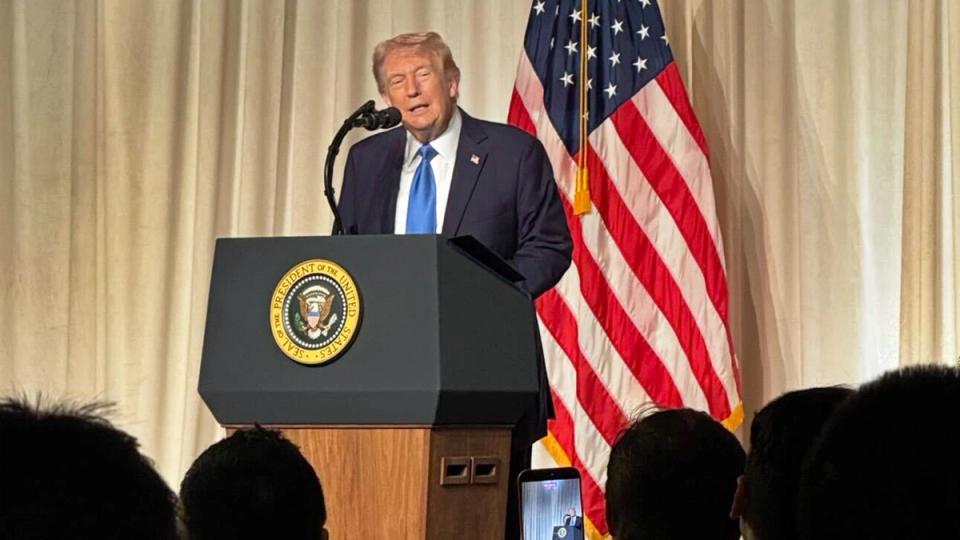
The Mar-a-Lago Declaration: President Donald Trump Defines Crypto as a 'Mainstream Industry' of the U.S. Economy, Signaling Regulatory Innovation
At an event held at Mar-a-Lago on April 25, 2026, President Donald Trump named cryptocurrency a 'mainstream industry.' This suggests that the administration's economic policies are being reorganized around digital assets.
On April 25, 2026, President Donald Trump officially declared cryptocurrency a 'mainstream industry' at a private event held at Mar-a-Lago. With key industry and cultural figures such as Mike Tyson and the CEO of Tether in attendance, this announcement is interpreted as a clear indication of the Trump administration's commitment to integrating digital assets as a core pillar of U.S. economic policy.
At the event, President Trump encouraged investors in meme coins named after him, emphasizing that cryptocurrency is no longer a speculative niche market but plays a pivotal role in the national economy. This represents a complete pivot from his previously skeptical stance on cryptocurrency, signaling full-scale administrative support.
This 'mainstream industry' declaration transcends mere political rhetoric, as it is based on massive transaction data from the actual market. The Trump administration has determined that the scale and liquidity of the cryptocurrency market have already reached levels on par with the traditional financial system, providing specific statistical figures to support this.
Cryptocurrency is now a mainstream industry. We will make America the crypto capital of the world, and for this, we will establish the gold standard of regulation.
According to actual data, the transaction volume of USD Coin (USDC) reached $18.3 trillion in 2025, accounting for a 55% market share, while Tether (USDT) also played a central role in global liquidity provision with a transaction volume of $13.3 trillion. Between July 2024 and June 2025, Bitcoin solidified its role as a market gateway, recording over $1.2 trillion in fiat inflows on centralized exchanges.
Legislative Momentum and Market Reaction
The Trump administration is accelerating the resolution of regulatory uncertainty through the 'Genius Act' and the 'Clarity Act.' On March 3, 2026, President Trump criticized Wall Street banks via Truth Social for delaying legislation due to provisions related to stablecoin profits, pressuring Congress for swift action.
- Immediately after Trump's critical post on March 3, 2026, the price of Bitcoin rose 5.2% in 10 minutes, surpassing $71,000.
- The Genius Act aims to strengthen U.S. technological leadership by providing clear guidelines for the cryptocurrency market.
- The Clarity Act is an attempt to promote the stability of the financial system by establishing a legal basis for the issuance and operation of stablecoins.
President Trump continues to exert strong pressure on the Federal Reserve (Fed), strengthening the link between monetary policy and the cryptocurrency market. He has demanded swift interest rate cuts from Chairman Jerome Powell to stimulate the crypto market, a risk asset, which is seen as a strategic move to expand market liquidity.
Following the end of Chairman Powell's term on May 15, 2026, President Trump is keeping the possibility open to appoint a successor more aligned with his economic policies. This change in Fed leadership is expected to be a decisive factor in creating a favorable financial environment for the cryptocurrency market.
Conflict of Interest Controversy and Market Reality
However, there is significant political pushback and ethical concern regarding these developments. Democratic Senators, including Elizabeth Warren and Adam Schiff, have raised conflict of interest issues between the meme coin business operated by the Trump family and policy decisions, demanding transparency regarding the scale of profits the President and his family derive from cryptocurrency ventures.
Market indicators show a somewhat different picture from the political enthusiasm. As of April 2026, the price of Bitcoin is trading near $77,700, maintaining its highs; however, data from TRM Labs indicates that global retail investor transaction volume in the first quarter of 2026 fell 11% year-over-year to $979 billion, suggesting a cooling in the retail market.
CFTC Chairman Michael Selig noted that the legislation being advanced by the administration will establish a 'gold standard' for the U.S. cryptocurrency market. Trump's vision to position the U.S. as the global center for digital finance is expected to take further shape alongside the Fed leadership transition in May 2026, serving as a major variable that could shift the landscape of global financial markets.
| Stablecoin | 2025 Volume (USD) | Market Share |
|---|---|---|
| USD Coin (USDC) | $18.3 Trillion | 55% |
| Tether (USDT) | $13.3 Trillion | 40% |
Dominance of USDC and USDT in facilitating global liquidity during the 2025 calendar year.


This content is for information and commentary only and is not investment advice.
Join the reader conversation
Read reactions to this article and leave your own note.